
Heron addict
The birds are back in town

OK. I’m thinking about herons again.
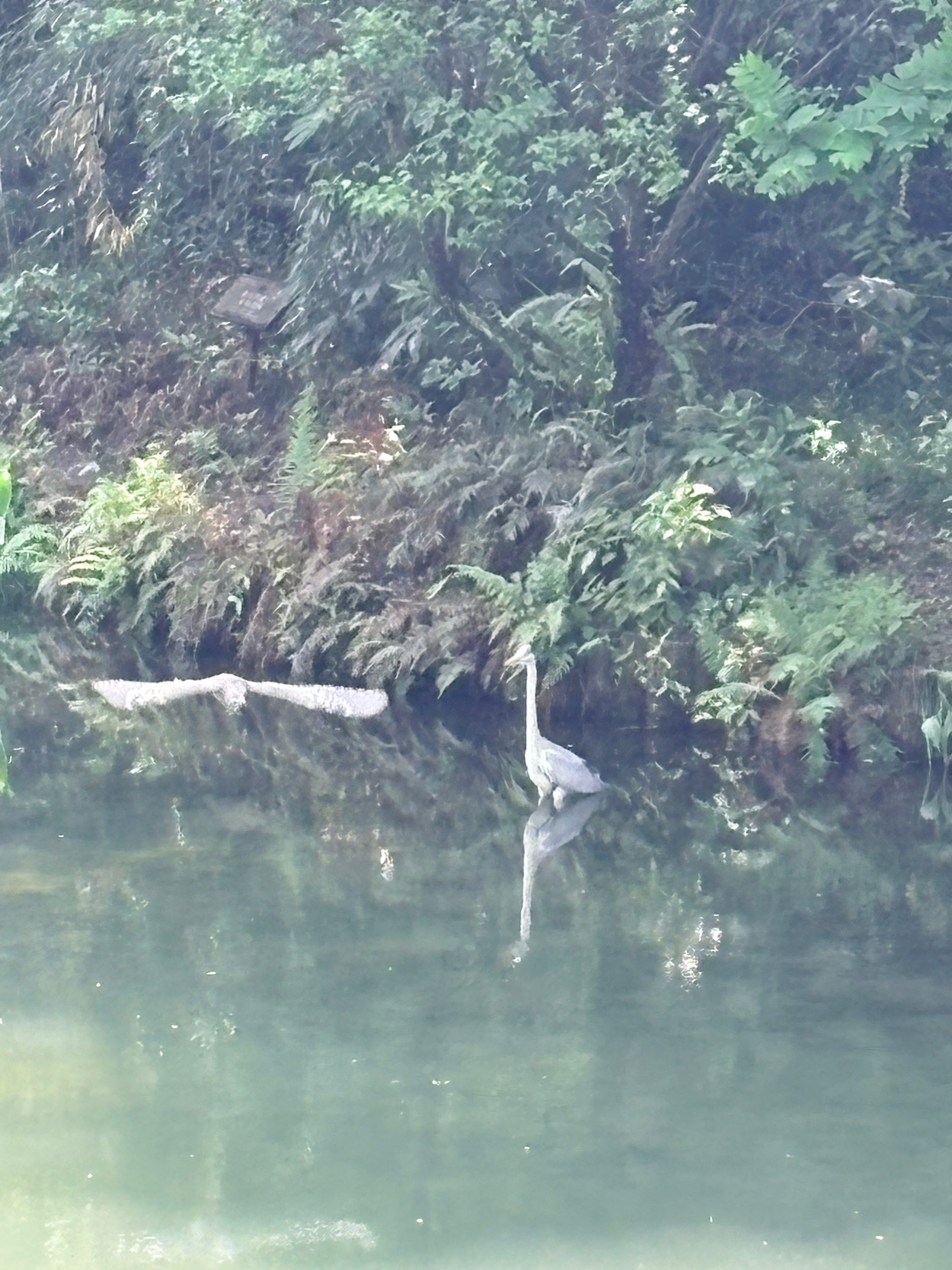
For a few years now, I’ve wanted to write a non-fiction book about my fascination with these majestic, liminal birds. It hasn’t quite found the right form yet, or rather I haven’t found the right way into and through it. But in China last week, I saw dark browed night herons for the first time: small, squat, intriguing herons, vase-shaped and still. I felt my curiosity reigniting. And I have a renewed sense of what preoccupies me about the heron.
More of that in due course. But for now, I’m going to start sharing some of my favourite ways-of-looking at herons here on A Time and a Place. 13 to be precise. Here’s number 1.
ONE: heron as birth-omen
I’m standing at the edge of the lake, feet in rufous mud, counting grey herons as if my life depends on it. As well it might.
The sky is arrowed with cloud. Everything seems to point towards the tips and tops of the trees. From a distance, the island is all spindle, branches February bare. One tree is broken, stooping towards the water as if to drink. The others are upright, skinny, each of similar height. Once you get your eye in, you start to see nests in the upper quarters. And then something pale stirs just a fraction, and the herons appear one by one. A grey presence still and stately at the edge of the water. One furled in a nest. Another. A pair, facing the same direction, looking north, prows on a ship. A heron taking flight and skimming low across the lake, leaving Heron Island behind.
My son is counting out loud with a six year old’s gravitas. Thirteen, mummy! He is solemn with concentration, He wants to borrow my phone to film the herons, holds it too close to the water, then he loses interest and goes back to swiping at the tops of grasses and brambles with a twig. Look! I’m breaking everything!
Ahead of us on the churned up path, my friend Nick is picking a route towards the bridge and the track back towards the statues of the Yorkshire Sculpture Park. He turns round to tell me that my name is actually an anagram of Heron Melt. We laugh and the boy laughs even though he doesn’t understand and I’m back on the path, truly, remembering that I’m not here alone.
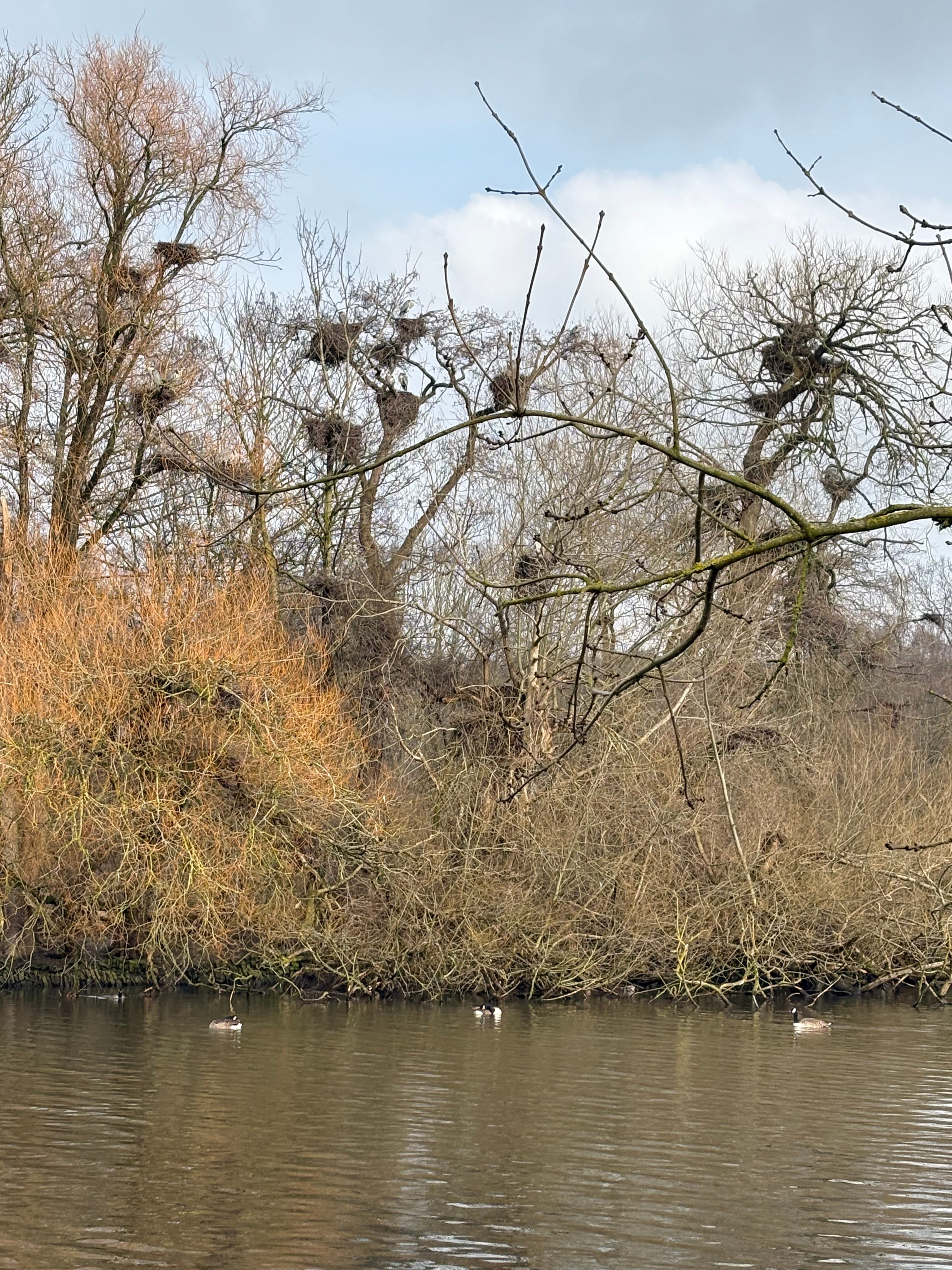
I glance back. Heron Island. There has been a herony at Bretton for several hundred years and the birds return annually to nest in the same place, the same trees, above the bulrushes and reeds. The Sculpture Park already seems otherworldly out of season, huge brightly coloured shapes rearing from the hillside, a massive sculpture that reads ‘LOVE’, the statued body of a pregnant woman by Damian Hirst, half her skull and muscles visible. We walk towards her, pulled. We stand beneath and look up at the marble bulge of her stomach, the impossible view of her carried child.
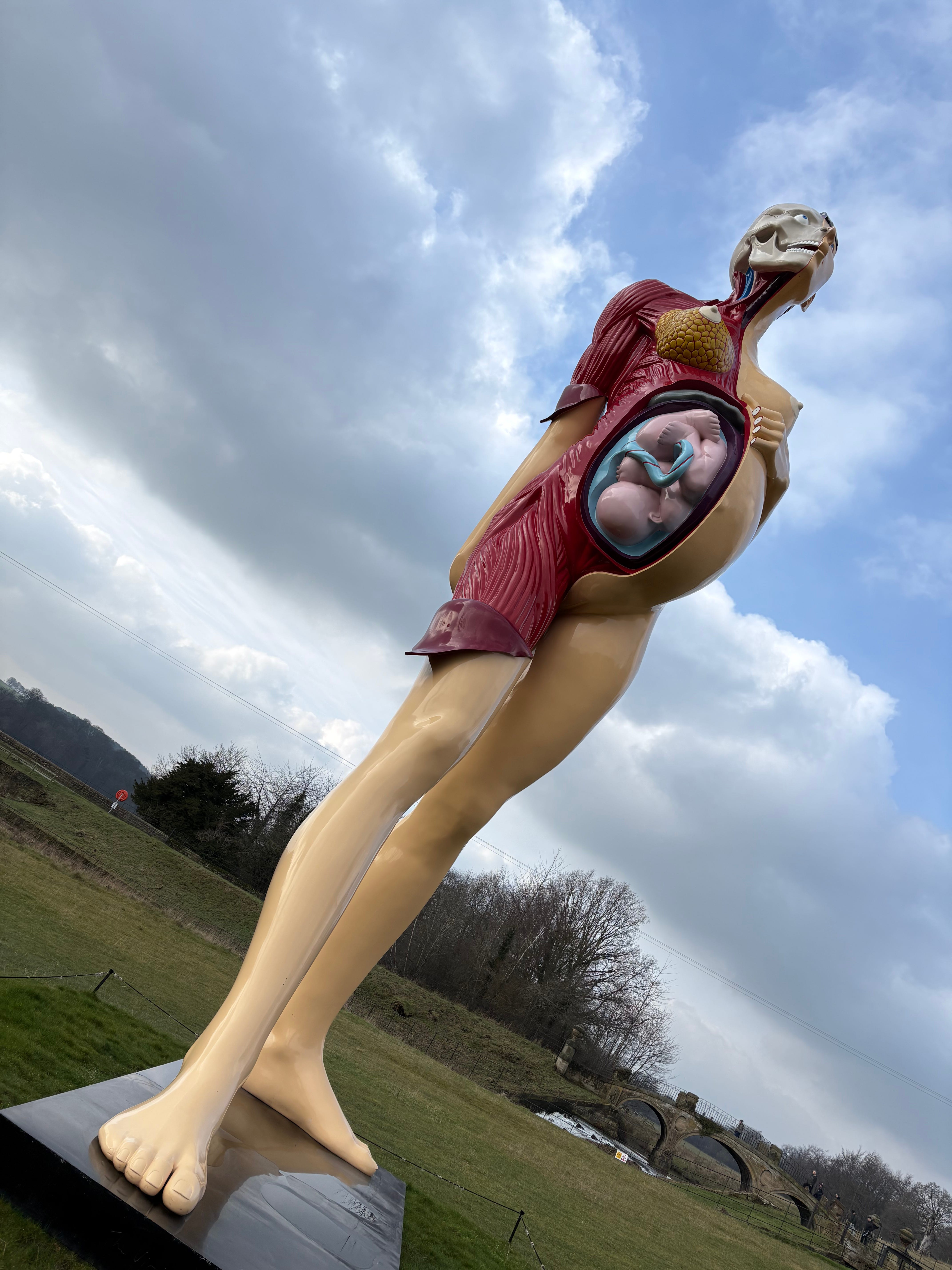
Damien Hirst’s ‘The Virgin Mother’ is bronze painted to look like shiny plastic. The pregnant woman has one foot in front of the other, slight intimation of walking. One arm is held just behind her and the other is bent at the elbow, hand resting on her belly. Approached from one side, she seems to have skin, but above her right kneecap it has been peeled away to reveal the vivid red of muscle. Half of her face is bone. On the right hand side of her stomach, we see the blue of an umbilical cord and then the pink foetus, curled up and bumpy, touched by the elements. The woman is ten metres tall, the tallest sculpture in the park. It is said to be partly inspired by an educational model of the human figure with removable skeleton and organs, but it is also partly a response to Edgar Degas’ statue of a girl, ‘The Little Fourteen-Year-Old Dancer’, cast in 1922, upturned face and foot angled outwards as if anticipating a plie. The Virgin Mother has her head arranged in the same way as Degas’ girl. We stand underneath her now and look up, speechless. Behind the sculpture, the herons are flying to and from their island.
My fascination with herons – the Arideidae family of stork-like birds, if we’re being exact – began when I was pregnant. I was approaching the end of ninth months carrying my son, Alfie. It was late November and Sheffield was under a damp grey towel of weather. I walked through suburbia slowly, enjoying the way the tree roots disrupted the tarmac on Sheldon Road, stepping fearfully all the same, almost wading, imagining every stumble and trip. That morning, I’d cried so hard in a car park over the steering wheel of my car my face had turned purple.
I thought I knew what I was weeping for. For most of a year, I had been carrying fierce life, feeling it under the surface of me, and I was both desperate to meet my son and utterly unprepared for motherhood. I felt unequal to the challenge. Each small gesture – making tea, folding clothes, frying onions and ginger – had become freighted. Every meal could be the last meal without my wished-for child. What if I couldn’t deliver him safely? What if I didn’t know how to behave? What if I didn’t know how to hold him outside the shelter of my womb? What if – whisper the words – I didn’t even know how to love him? I sobbed with the car windows steaming up and people walking past, oblivious or embarrassed. I phoned my friend Rachel, poet and mother of three. She would know what to say.
“You’re so close now,” she told me “You can talk to him if you want to. Put your hand on your stomach and tell him you’re ready to meet him. Tell him what you feel.”
My breathing slowed down. My heart was beating almost normally.
“Ok,” I murmured.
“He’ll come when he’s ready. There’ll be a sign.”
I took a big lungful of air, got out of the car and went to swim in the artificially blue swimming pool, up and down, past the bored lifeguard and the cafe. As I got out an aquacise class for the elderly was beginning, thumping music, women waving their arms above their heads as one, skin velvety and jewelled with water.
I left the car in the car park. I wanted to walk home instead, uphill, head down. At Nether Edge crossroads, I stood at the pedestrian crossing, lost in thought. I was irritating the drivers – pressing the button and then missing the moment to go. The shrill sound of an ambulance in the background was enough to almost make me cry again. It was cold. I had an iron-like taste in my mouth. I noticed missing roof tiles on the buildings I’d never thought about before.
As I stood there, unready to cross, I spotted something. A silk scarf carried in the wind, or a bit of fallen cloud, a scrap of sky descending. Grey heron, flying over suburbia, arcing above our world, so languid. I watched its wings sieve the air.
As I stood, it slowed towards the roof of a house opposite, settled on the chimney pot. It tucked itself back into its sleek body and stayed. It stayed and I stared at it. It was almost a cliché, the stork-like creature visiting at the crossroads of my life. I resisted the idea, leaned towards it all the same.
That night I ran a deep, lukewarm bath and sat in it, speaking out loud to my son.
“I saw a heron today, Alfie. It came from nowhere and it made me think of you. I’m looking forward to meeting you. You can come out now, you can come out when you’re ready.”
I went to bed. At five am, my waters broke and my labour began. He was born the next day, the first of December. Advent.