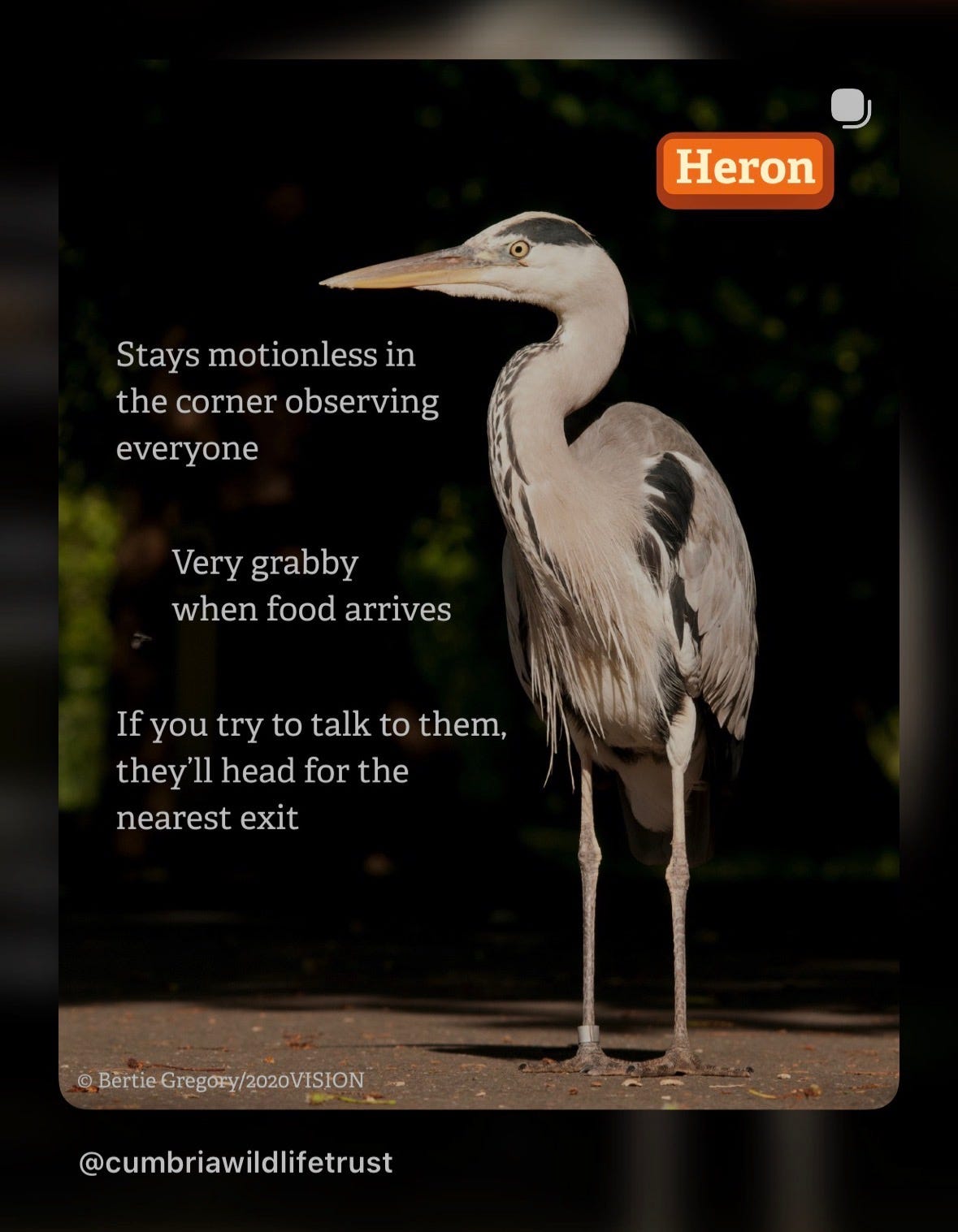
Heron as flawed joy-flight
'I didn't make the heron up'

Ways of looking at a heron number god-knows-what
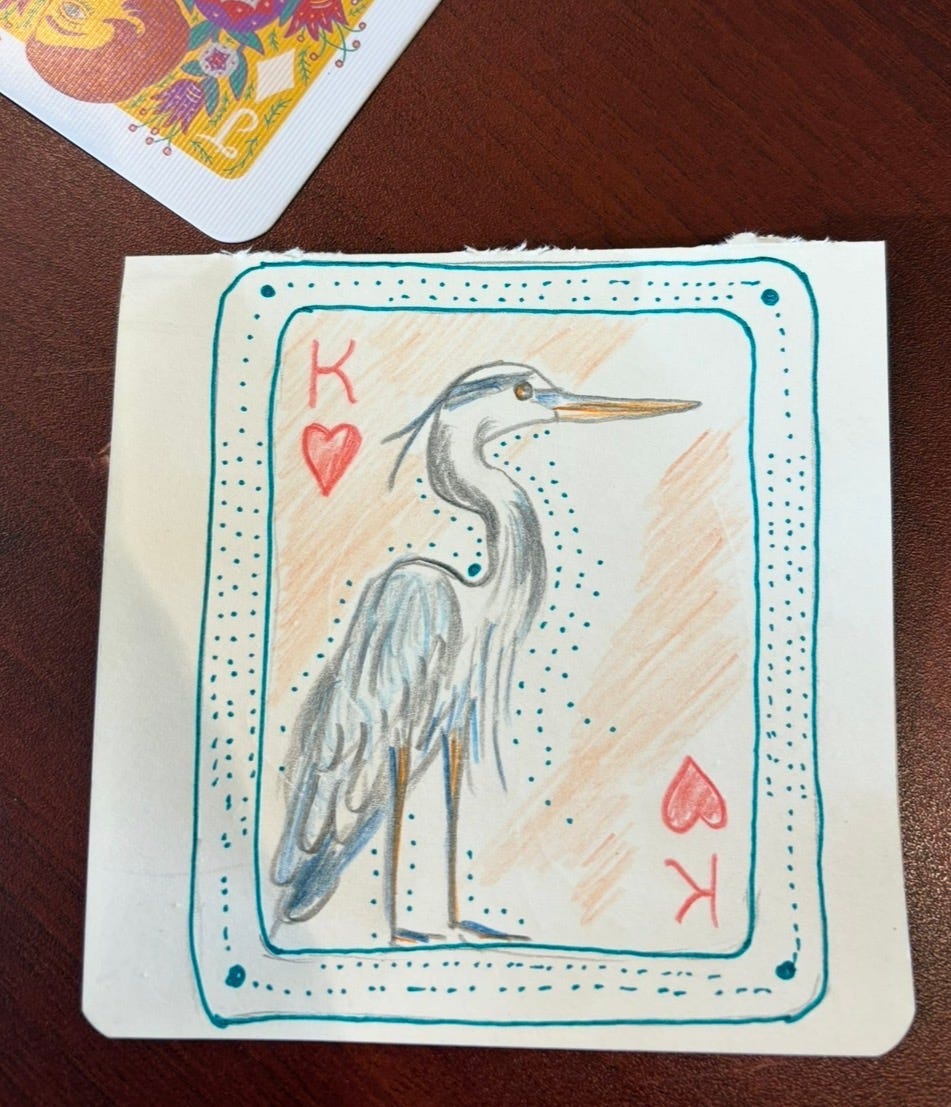
In Lord William Percy’s ‘Three Studies in Bird Character’, he describes a rare communal aerial display by a group of herons:
‘An individual returning from the fishing grounds in the usual long descending glide on set wings suddenly alters course and begins circling low over the tree tops. As this first bird swings upward, loud yelps burst from it as if to summon the community to a grand parade. One by one the birds on the nests sweep up to join it until at length the whole company is soaring in spirals on motionless wings like vultures far up in the blue vault of heaven almost to the limit of human vision. As each circling bird turns and the sun strikes the dove-grey back and white neck, the company seems to sparkle with intermittent glints of light….. finally, with necks outstretched to their full extent, they ‘peel off’ by twos and threes in giddy, twisting, ‘falling leaf’ dives to the tree tops below.’
The blue vault of heaven. Yes. Almost to the limit of human vision – and perhaps beyond it. Because how would we know?
Percy calls the spectacle a ‘joy flight’, but acknowledges he’s flirting with anthropomorphism. Do herons feel joy? It is, he notes, the kind of thing that would arouse the scorn of a rational person, of ‘the seeker after truth desiring to see no more than there is to be seen, nor less than there is to see’.
I misread that at first. I read ‘desiring to see no more than there is to be seen OR less than there is to see.’
Desiring less than there is to see. I think some people move through the world like that, engaged in a purposeful narrowing. They have learned how to please themselves. I don’t blame them: it is more comfortable than seeing and feeling everything at once, the heart summoned from its nest by the wing-beats of another. Summoned into the air only to fall back again, to be tangled in branches.
It is painful enough to see what there is to see in this world, let alone want more. Safer by far to stay in the nest.
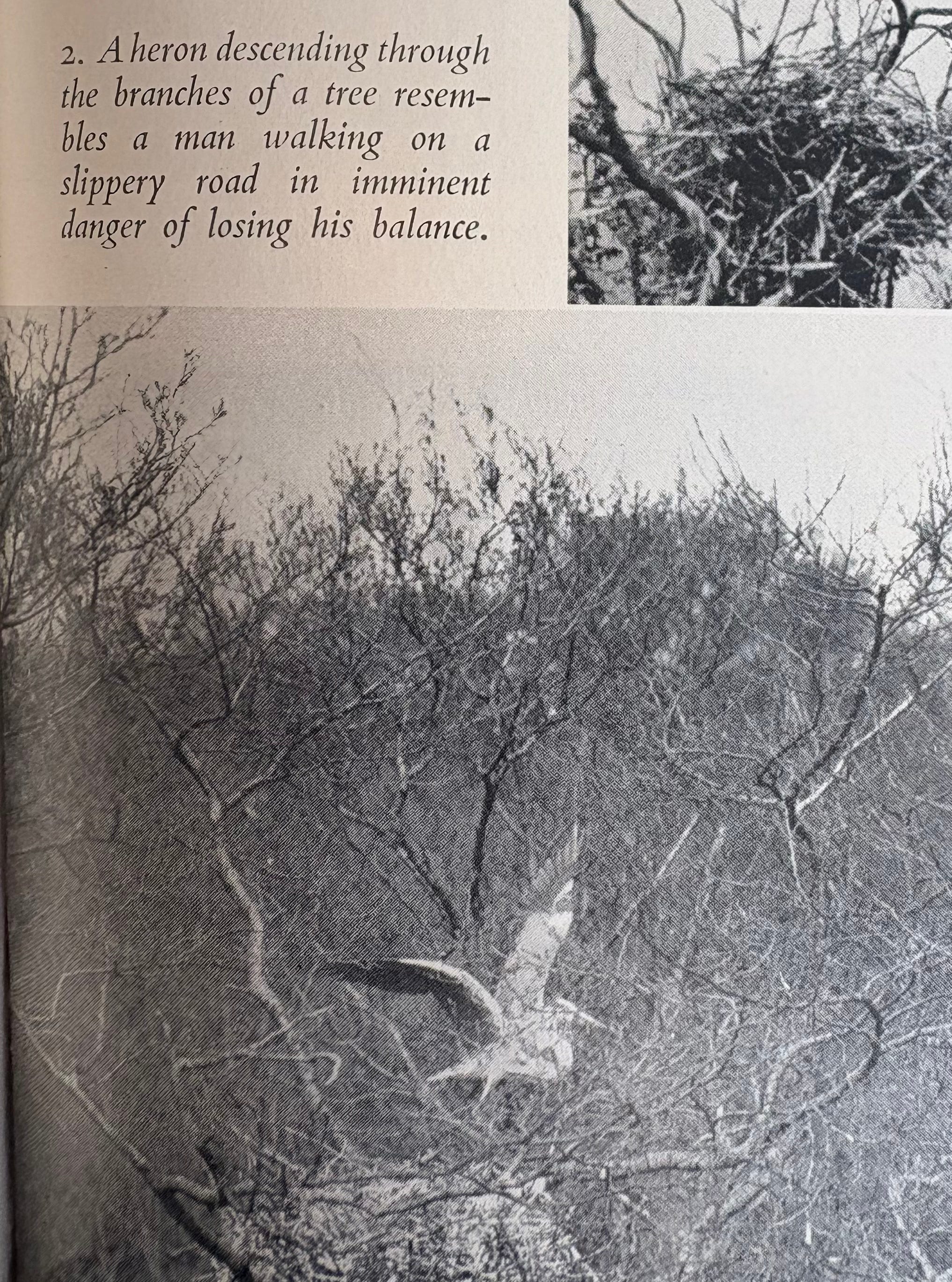
To the scientific observer, then, the ‘joy flight’ is a misnomer:
‘….it must be seen in terms of ‘conditioned reflexes’, upward air currents and aerodynamics. Upward air currents are no doubt essential for the performance no less than external conditions to many forms of human enjoyment, but does the fact that they are necessary concomitants detract from it as a manifestation of the sheer joy of living?’
On a boat in East Greenland years ago, I saw a clutch of gulls turn as one in flight and sparkle in the same way Percy describes the herons sparkling. There were two whales metres from the boat, rising and falling in parallel as the gulls undulated on their current of air. I was sitting next to my friend Bill. We were not wearing life jackets. The engine was so loud he couldn’t hear what I was saying to him, but what I was saying was “if I died in this moment, it would be ok”.
I’m glad I didn’t die then. Apart from anything else, I still had so many beautiful mistakes to make. So many joy-flights. So many ungainly falls.
In William Trevor’s novel ‘Reading Turgenev’, the protagonist Mary Louise falls in love with her cousin Robert, though she is married to another and Robert is extremely ill. They go for short walks together and Robert promises her a heron in the stream beyond the vegetable beds he tends. Mary Louise has never seen a heron before:
‘I’ll show you some time. And the heron’s really there too, you know. I didn’t make the heron up.’
‘I didn’t think you made the heron up. Why would you do that?’
‘To make you come back’
One day, they glimpse it:
‘Mary Louise could see, at the very place where they often watched the fish going by, the grey, angular form of the heron they had hoped for so long to catch a glimpse of….. it stuttered closer to the water on its ungainly legs, then turned, spread out its wings and flew away’.
Back at the house, they look the heron up in a reference book and he asks if he may kiss her. He tells her she is beautiful and she replies that she is not in the least. ‘Actually you are,’ says Robert. They have tea in the kitchen. She goes home.
I discovered William Trevor through someone who later frightened me. I felt the wing-stirrings of grave danger. Perhaps, then, it would be better if I had not. But no -I’ll always be grateful for the herons in Reading Turgenev. It is a spare, delicate novel about regret and entrapment, love and survival. The herons in it are a symbol of release, totem of could-have-been. If I were a wiser, more guarded person, I might not have encountered them.
I can never wholeheartedly dismiss anything that led me to this, the passage in the book where Robert dreams of Mary Louise. It happens after a day when they have talked about her wedding day, the pub she went to, the people she met.
‘That night, a few minutes before midnight, Robert dreamed that it was he who accompanied his cousin on her honeymoon to the seaside. The three men described to him were standing on a road, and on a wide, endless strand a flock of seagulls swooped down to the edge of the sea…. As soon as the birds touched the sand they were seen to be herons. He put his arm around his cousin’s waist and as they walked on the strand they talked about his father. In that moment Robert died’.
I wish you joy flights. I wish you unguardedness. I wish you more than there is to see.