
The heart cannot be automatic
On lighthouses

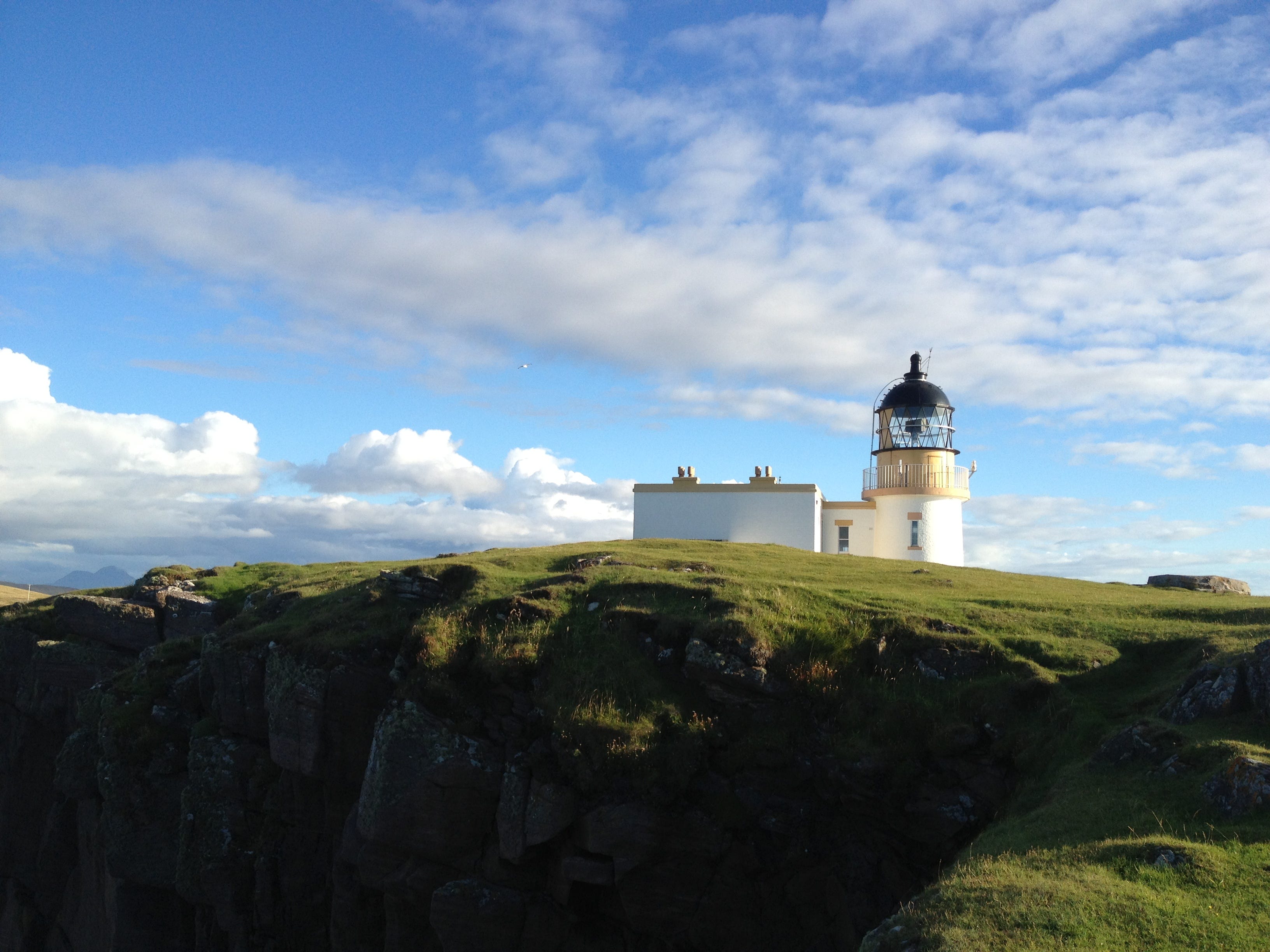
I’ll never forget the lighthouse at Muckle Flugga, Shetland, the most northerly light in the UK. I went there around 2010 or 2011, walked an absent path through bog against an unforgiving wind, the landscape weirdly treeless. Lunar. Late afternoon, dark soon.
Eventually, it came into view: a stately tower off the shore of Unst, bright white against the tin coloured sky. I remember thinking there was something almost religious about it. Sea-church. I stood and faced true north until the wind tried to uproot me and I had to turn away from the waves. The sound chased me as I retreated.
I’ve been busy over the last few months exploring why people are drawn to the image of the lighthouse, why so many of us have fantasised about running away to live in a tower overlooking the wild deep. The Last Sweeping Beams was broadcast on Radio 4 yesterday and you can listen to it here.
The lighthouse-as-metaphor has another layer of significance for me. My first pamphlets were published by the one and only tall-lighthouse press in Lewisham, founded by Les Robinson, creative mentor and dear friend. As well as a publishing house, tall-lighthouse was (is) a family. Anthologies like ‘city lighthouse’ and ‘automatic lighthouse’ were beacons in the dark. Les kickstarted the careers of so many poets, and the tall-lighthouse offices in Lewisham for me always felt like a homecoming, a place of safety. The name is completely apt.
Making ‘The Last Sweeping Beams’ with producer Megan Jones was an exhilarating experience but also a melancholy one. We interviewed Joe Moran about his love of lighthouses, talked to Emma Stonex about her thrilling novel The Lamplighters, invited Glyn Maxwell to discuss Derek Walcott’s poem The Lighthouse and the significance of its imagery in poetry. But we also waved farewell to an era.
Lighthouse traditional optic lenses are things of strange beauty, their concentric glass prisms refracting light into a powerful beam that sweeps across the sea. But these lights need to evolve over the next decade to remain fit for purpose – reliance on mercury in the rotating system is hazardous, new LED lights can be powered by solar. The rotating, sweeping beams have been replaced by a very different signal, an LED flash (though it looks the same to mariners at sea). Lighthouse automation began through the 1980s and 1990s and there are now no longer any people-operated lights in the UK. Working lighthouses are becoming an endangered species, sometimes decommissioned to become tearooms and holiday lets.
But lighthouse as metaphor… that endures.
I wrote a new radio-poem for The Last Sweeping Beams, and I thought I’d share the text of this with you. It was created to bridge the different parts of the programme and was written for the air rather than the page, or rather for the airwaves. Here it is, untitled, sort of lighthouse shaped.
I
I write to you from deep inside the source
of the last great sweeping beam.
I speak through the alien eye
of a Fresnel lens. A prism, human dream
of radiance: desire precise enough
to split the restless sea, to make a path
that moves and pulses, draws
a line - unwavering - on the ocean’s back.
Imagine water had a spine. Imagine night
had a faultline. Imagine collimated light
where all the rays have to align
and work in parallel. And if you can’t,
think of three things you wanted fiercely,
couldn’t have, and how you learned to keep them
in your mind, unspooling separately. Like that.
Some light is only focused on infinity.
II
Or think of a child up late and swaddled
under covers with a book and torch,
so focused on the lit circle of words
the page ignites; the story scorches everything.
Think of a city. In it, a woman who can’t sleep
watches the strobe of headlamps on her wall
remembering a cottage by the coast
a light that came to call for her at 1am,
and held her, hypnotised. It was a tall, cool
glass of light. It was a here-then-gone-then-here,
a heartbeat, soothing, from the deep unknown.
A wild, sensed song. Not quite a song of fear,
but not quite comfort either. Think of her
inland and yearning for the sea
the lighthouse throwing its voice, its beam,
the lens that saved a million ships unseen.
Think of my mother, waking from the winter
when she lost the will to – no, don’t say it.
Think instead of how she clambered out,
a pencil-width of light in a black cathedral.
Think of light’s sequels. Think of
all light’s sequels.
III
The heart cannot be automatic.
there is a bright, unruly beam
that only the skilled can operate
with hands and the seam of their nerve.
How can we hope to save each other
when the sea covers for the rocks so well
when the dangers are invisible, the distance
swells, our light is threadbare?
I mean to say: even if my need
is dazzling and inconvenient, unchecked,
outdated, even if it hurts to look at it,
what if it was all that kept you from wreck?
IV
Well. Be an empty lighthouse then.
stand on your nest of bruising rock.
Work calmly, without intervention, no keeper
to tend the lamp and watch the clock.
Love touch only as metaphor.
V
Know touch as metaphor.
If there are monsters in the deep
they might – one day – draw close to you
and one more curious might pause,
investigate, as if it could love you,
for pausing is the start of love.
It might appraise your towering, lonely height
haul itself upright, scattering water
diamond-bright, it might draw level, might
look hopefully towards you, look you
in the place your eye should be
and find you cool, efficient, lensless
LED.
Thank you for posting the text of your poem. I so enjoyed
listening to the poem as it wove it's way through the radio programme and now I can read it too and be transported back to the sea !